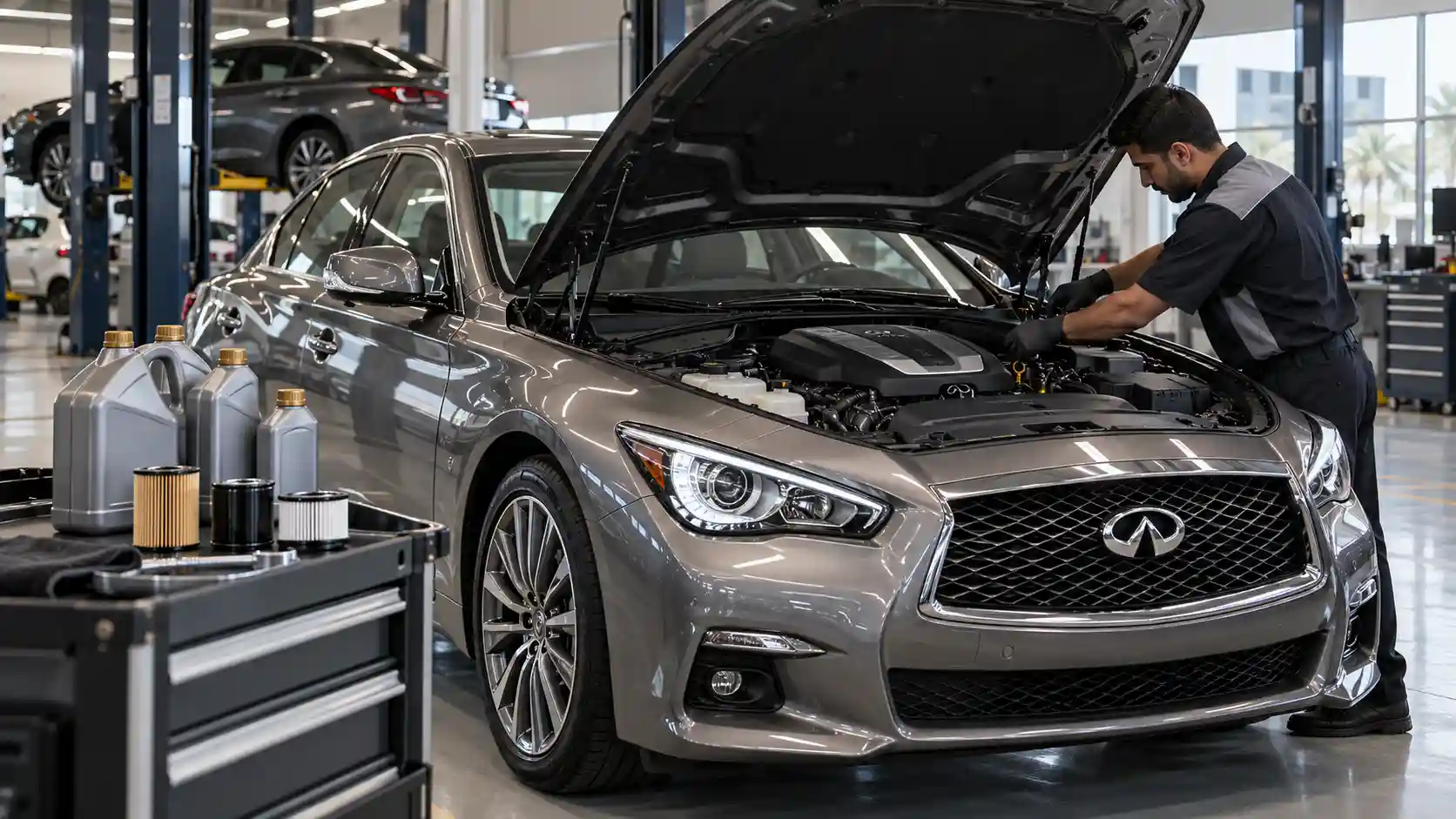
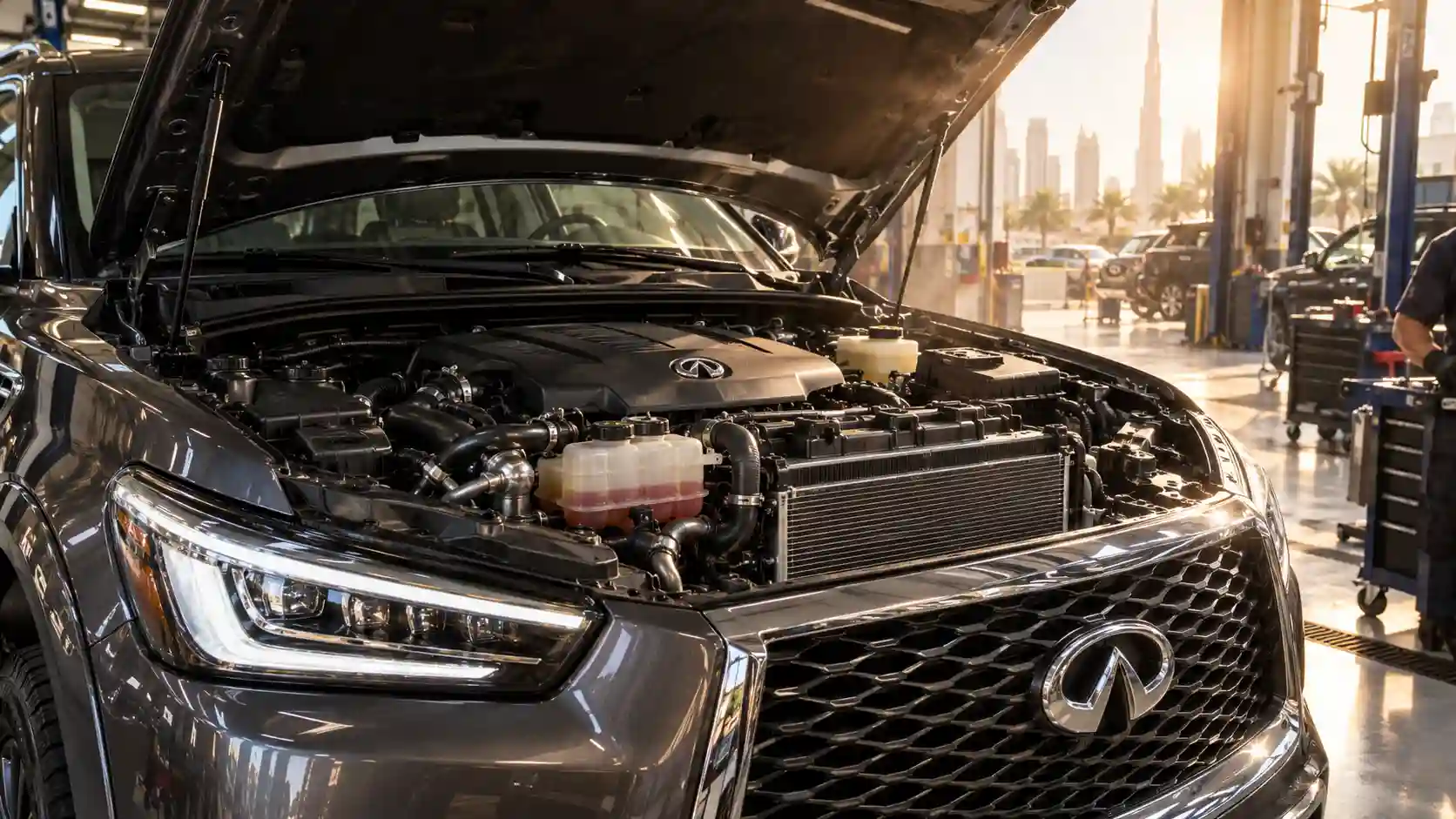
Common Infiniti Problems UAE Owners Should Watch
Infiniti problems are not the same across every model. Knowing the early signs can help owners repair a small fault before it becomes a costly problem.
Air Conditioning Problems
The AC system works hard in the UAE, especially during summer. Weak cooling can come from low refrigerant, a dirty condenser, a blocked cabin filter, a weak compressor, a faulty cooling fan, or an electrical fault.
Some Infiniti models can also develop problems with climate control parts or air direction controls. If the AC is cold while driving but becomes warm when the car stops, the cooling fan or system pressure should be checked. Strange smells, weak airflow, or different temperatures from each side also need inspection.
Transmission and Gearbox Problems
Transmission behaviour should always be taken seriously. Depending on the Infiniti model, the car may use a CVT or a conventional automatic transmission.
Signs of trouble can include delayed movement, shuddering, slipping, harsh gear changes, whining noises, or high engine RPM without normal acceleration.
CVT-equipped models such as some QX50 and QX60 versions need particular attention to fluid condition and transmission behaviour.
Do not assume every transmission problem means the gearbox needs replacement. A proper diagnosis can check fluid condition, pressure, fault codes, software, and mechanical parts first.
Engine Overheating
High temperatures make the cooling system one of the most important parts of an Infiniti. An overheating engine can be caused by low coolant, a leaking hose, a damaged radiator, a weak water pump, a faulty thermostat, or a cooling fan problem.
Warning signs include a rising temperature gauge, coolant smell, coolant loss, steam, or an AC system that stops cooling properly while the engine is hot.
Driving with an overheating engine can cause serious damage. If the temperature rises above normal, stop safely and have the cooling system checked rather than continuing to drive.
Battery and Starting Problems
A weak battery can cause more than a slow engine start. Modern Infiniti cars have many electronic systems, so low battery voltage can sometimes trigger warning lights or unusual electrical behaviour. UAE heat can also shorten battery life because high temperatures speed up battery wear.
Watch for slow cranking, dim lights, repeated warning messages, or a need to jump-start the car. A battery test should include its starting ability, not only its resting voltage. The alternator should be tested too because a healthy charging system is needed to keep the battery working properly.
Infiniti Engine Problems to Watch
The engine is one of the most important parts of any Infiniti, and early signs should not be ignored. Some issues are linked to normal wear, while others can develop because of poor maintenance, low fluid levels, overheating, or delayed repairs.
Older Infiniti models can also have age-related problems with seals, hoses, sensors, and other parts. Regular oil changes and inspections help reduce the risk of major engine damage.
Oil Leaks and Oil Consumption
Oil leaks can develop around gaskets, seals, covers, and other engine components as a car gets older. Small leaks may first appear as oil spots under the vehicle or a burning oil smell after driving. Low oil levels can become dangerous if the problem is ignored.
Some Infiniti engines may also use more oil as mileage increases. Owners should check the oil level regularly and look for changes in consumption. If the oil level keeps dropping between services, the engine should be inspected for leaks or internal oil consumption.
Turbocharger Problems
Some Infiniti Q50 and Q60 versions use the VR30 twin-turbo V6. Turbocharged engines produce strong power, but the turbo system adds more components that need proper lubrication and cooling. Possible warning signs include reduced power, unusual whining sounds, smoke, poor acceleration, or an engine warning light.
Oil quality and service timing are important for turbo engines. A problem with a turbocharger should not be guessed from symptoms alone because boost leaks, sensors, hoses, and other parts can create similar signs. A diagnostic scan combined with a physical inspection can help find the real cause.
Rough Idling and Misfires
A rough idle can make the engine shake or feel uneven when the car is stopped. Common causes include worn spark plugs, ignition coil problems, dirty throttle bodies, air leaks, fuel system faults, or sensor problems. A misfire can trigger the check engine light and may affect fuel use and performance.
Ignoring a repeated misfire can cause further damage, especially if unburned fuel reaches the catalytic converter. If the check engine light flashes or the engine shakes badly, the vehicle should be inspected as soon as possible.
Infiniti Suspension and Brake Problems
Suspension and brakes deal with constant road loads, speed bumps, heavy traffic, and braking. Over time, bushings, control arms, shock absorbers, brake pads, and discs can wear. UAE driving conditions can make these parts worth checking during routine service, especially on high-mileage cars.
Suspension Wear and Noises
Worn suspension parts can cause knocking sounds, uneven tyre wear, poor handling, or a rough ride. A worn control arm bushing may allow unwanted movement, while weak shock absorbers can reduce stability over bumps.
If the steering feels loose or the car pulls to one side, the problem may involve alignment, tyres, suspension, or steering components. A proper inspection should check these parts together instead of replacing one part without finding the actual cause.
Brake Pad and Disc Wear
Brake pads naturally become thinner with use. Heavy city traffic means drivers may use the brakes many times during a normal trip, increasing wear. Worn pads can produce squealing or grinding sounds, while damaged or uneven discs can cause steering wheel vibration during braking.
Brake inspection should include pad thickness, disc condition, brake fluid, and calipers. If the pedal feels soft, the car takes longer to stop, or the vehicle pulls while braking, the braking system should be checked without delay.
Infiniti Electrical and Sensor Problems
Modern Infiniti models rely on many sensors, control modules, cameras, screens, and electronic systems. A fault in one part can sometimes create several warning messages.
Common symptoms include warning lights, screen problems, parking sensor faults, battery drain, or features that stop working.
A diagnostic scan can help identify stored fault codes, but the code alone does not always identify the failed part. For example, a sensor-related code may be caused by damaged wiring or another mechanical problem.
Good diagnosis includes scanning, checking live data, testing wiring where needed, and inspecting the related component before replacement.
Infiniti AC and Cabin Problems
The AC deserves extra attention in the UAE because drivers depend on it for much of the year. Weak airflow can come from a blocked cabin filter or blower problem, while warm air may be linked to refrigerant loss, compressor issues, condenser damage, or a cooling fan fault.
An AC system should not simply be refilled with refrigerant every time it stops cooling. If the refrigerant is low, there may be a leak.
Finding and repairing the leak is more useful than repeatedly adding gas. The condenser, compressor, evaporator, pipes, pressure readings, and electrical controls may all need to be checked.
Which Infiniti Models Need Special Attention?
Different Infiniti models have different areas that owners should watch. This does not mean every car will develop these problems. Maintenance history and driving conditions have a major effect on reliability.
Infiniti Q50 and Q60
Q50 and Q60 models can use different engines and transmission setups depending on year and trim. Turbocharged versions need careful attention to oil, cooling, boost pressure, and related sensors.
Transmission behaviour should also be monitored for shuddering, slipping, or delayed engagement. Owners should not ignore warning lights, unusual acceleration changes, or new engine noises.
Infiniti QX60
The QX60 is a large family SUV, and some versions use a CVT transmission. During a test drive or routine inspection, watch for hesitation, shuddering, unusual noise, or delayed response. Suspension parts can also wear with mileage, particularly when a vehicle is regularly driven over rough roads or speed bumps.
Cooling and AC performance are also important because the SUV has a large cabin that needs strong climate control during UAE summers.
Infiniti QX80
The QX80 uses a large engine and has a heavy body, so its brakes, suspension, tyres, and cooling system have important jobs. Older QX80 models can develop age-related problems involving hoses, suspension bushings, cooling components, batteries, sensors, and electrical equipment.
Owners should check for oil leaks, coolant loss, brake vibration, uneven tyre wear, suspension noises, and electrical features that do not work consistently.
Final Thoughts
Most Infiniti problems become easier to manage when they are found early. Regular oil and fluid checks, cooling system inspections, AC service, brake checks, battery testing, and computer diagnostics can help keep the car reliable for longer. The exact maintenance needs depend on the model, engine, age, mileage, and previous service history.
For Infiniti owners in Abu Dhabi, a proper inspection is especially useful when buying a used car or when a warning sign appears. A complete check of the engine, transmission, suspension, electrical systems, cooling system, and AC can help identify faults before they become larger repairs.